


The year was 1966, and Chevrolet was scrambling to cash in on the brand-new pony car market created by the seemingly unstoppable Ford Mustang. Somewhat to the detriment of Nova and Corvair, the brand swiftly brought Camaro to market, a name which marketeers jokingly christened as a small animal that eats Mustangs. Offering everything from an inline six to big-block V8s, the Camaro was a major sales success. But Chevrolet wanted more… Chevrolet wanted to best Ford both in the showroom and on the track.
Stunt On Sunday, Sell On Monday
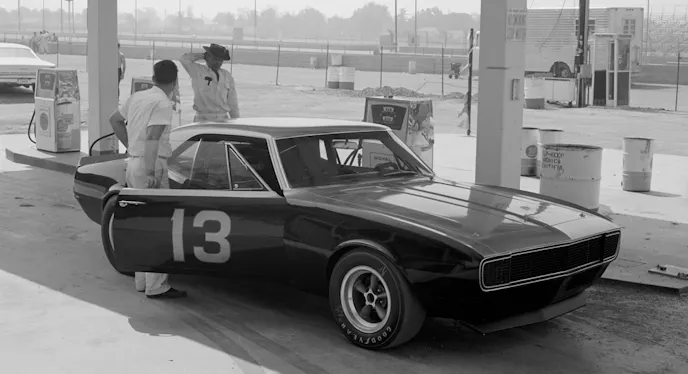
While General Motors had officially banned corporate racing efforts back in 1963, USA-1 was still stacking select race teams with parts, money, and plenty of engineering support. While Chevy reached out to Penske and Mark Donahue with a plan that would eventually provide long-term success, the brand also maintained contact with NASCAR outlaw Smokey Yunick. Yunick was infamous for exceptional creations that walked a fine line between racy, illegal, and flat-out scary.
Like most things that came out of his “Best Damn Garage In Town,” Smokey Yunick’s hemi-head Camaro is a legendary example of racing ingenuity and rule-bending. Yunick was well known for pushing vehicle engineering to extremes, commonly using acid-dipped body panels and thinner glass to save weight, reshaping aero elements to increase speed, and raising subframes and floorpans to lower ride height. But what makes his hemi-head Camaro so shocking is its sheer audacity.
Who Needs The Factory?
Now, when we say Smokey Yunick built Z/28 Camaros, we mean he actually built the cars from the ground up. Smokey requested bare bodies from General Motors, which he promptly dipped in acid and dropped on a completely re-engineered and lowered subframe. He then installed a fully rebuilt engine before incorporating a roster of aero tweaks and gluing Z/28 badges to the fenders. In 1967, Smokey’s Camaros reportedly set over 30 speed and endurance records. By 1969, Smokey had evolved his Camaro program to include a prototype 302 small-block that featured semi-hemispherical heads.
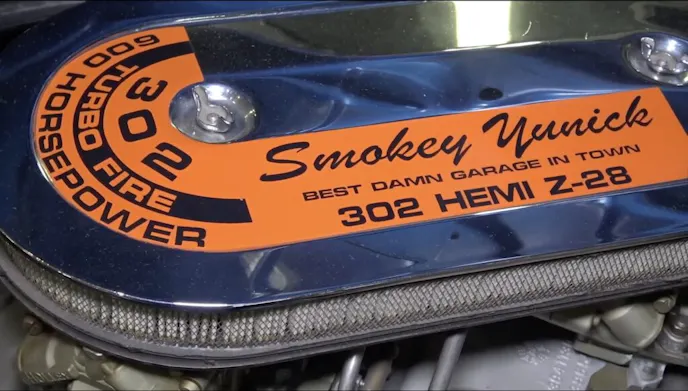
But that wasn’t all. Far more than a simple factory casting with hot rod caps, Smokey’s 302 was an all-aluminum tour de force built around revised 12:1 pistons and relocated spark plugs. A custom cross-ram intake maximized airflow and increased high-RPM horsepower with the help of two 585 cfm Holley carburetors. Those carbs were fed by custom cowl induction, and the semi-hemispherical heads hid optimized porting and canted and enlarged valves under custom magnesium valve covers. At the end of the day, Yunick had built a brutal and temperamental small block that pushed out over 500 horsepower on the dyno while happily revving past 8,000 rpm.
Just Too Good
While Yunick’s hemi-head Camaro did set various speed and endurance records at Bonneville, it never scored a Trans Am victory in the possession of its creator. Not surprisingly, SCCA promptly disqualified the car for chassis and body modifications. That said, the Camaro’s performance was undeniable, and Don Yenko, who purchased the car in 1969, would eventually pilot it to victory in NASCAR Grand Touring competition.
Despite its amazing potential, the hemi-head 302 never truly made it past the prototype stage. For Chevrolet, production of such a costly and volatile engine seemed pointless since Mark Donahue had already made the 302 super competitive and, by extension, made the Z/28 a champion. To Yunick, the decision was purely political, since he had been shunned from both NASCAR and SCCA competition.
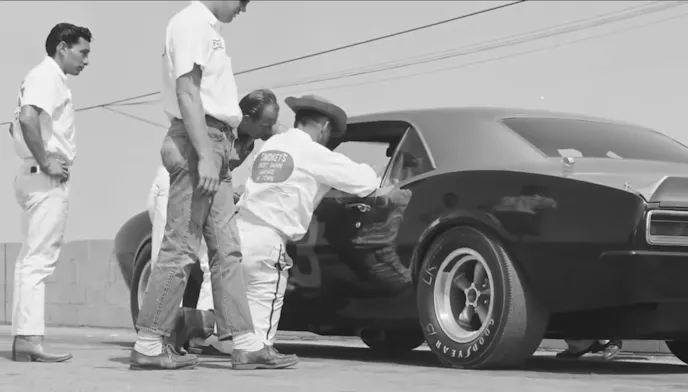
Though it never reached mass production or full competitive potential, Smokey Yunick’s hemi-head 302 is cemented in muscle car history as a showcase of technical innovation and exclusivity. Like its creator, a B-17 pilot turned performance engineer, the engine is a symbol of talent, rebelliousness, and good old American ingenuity!
You might also like
Classic Style, Modern Control: Art Morrison’s GT Sport Chassis For Early Chevys
Art Morrison's GT Sport chassis transforms the timeless 1949-54 Chevrolet into a serious restomod performer.