
David Freiburger’s latest deep dive on YouTube is less about the car he’s working on and more about the universal truths behind carburetor behavior. Whether you drive a classic Chevy small-block, a big-block street cruiser, or a weekend bracket car, the questions he tackles are the same ones enthusiasts have debated for decades: 750 CFM versus 600 CFM, double pumper versus vacuum secondary, and how to tune each circuit for clean drivability. Freiburger uses his own project as a testbed, but these carburetor tuning tips, circuit behavior, and real-world results apply directly to the majority of carbureted engines on the street today.
His goal wasn’t chasing peak horsepower. It was improving response, cleaning up tip-in, and making a carb behave predictably under real conditions, something every carbureted Chevy owner could relate to.
Testing Common Advice On The 750 Double Pumper
The episode begins by revisiting a 750 CFM double pumper that Freiburger had previously tuned into shape, even though it was larger than the engine truly needed. Viewers offered two major suggestions: change the accelerator pump cam and switch the vacuum advance source from manifold to ported. Both ideas are common fixes across Holley-style carburetors, so Freiburger tested them exactly as suggested.
He replaced the mild pink pump cam with an aggressive blue one and reset the linkage for proper pump-shot timing. He then moved the vacuum advance hose to a ported source and took the car out for multiple test drives. Despite the adjustments, the carb still suffered from a lean tip-in stumble. The new cam delivered fuel sooner, but not in a way that solved the problem. The advance change didn’t improve anything either. The result reinforced a point many Chevy tuners already know: a 750 can be made to work on a mild engine, but it often requires extensive, sometimes awkward tuning to mask mismatched airflow characteristics.
Why The 600 Vacuum Secondary Made Immediate Improvements
Freiburger switched to a 600 CFM Quick Fuel Slayer vacuum secondary, a size much closer to what a mild small-block Chevy typically needs. This carburetor features adjustable idle feed restrictors, adjustable power valve channel restrictors, replaceable secondary jets, and an external secondary opening-rate adjustment. Immediately upon installation, the engine idled cleaner, responded more quickly, and displayed stable AFR readings.
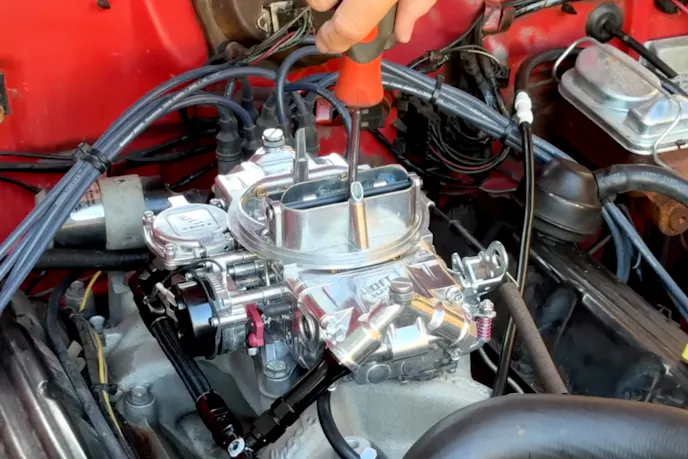
He fine-tuned it further by richening the idle circuit for better light-cruise AFR, swapping to a 10.5 power valve to start enrichment earlier, and leaning out the secondary side to eliminate the overly rich 10:1 wide-open throttle condition. Adjusting the secondary opening point cured a minor lean spike under heavy throttle. Once he completed these refinements, the carb operated smoothly, transitioning from idle to full throttle without any hesitation or bog.
The Takeaway For Chevy Carb Tuners
After extensive road testing, Freiburger proved what many tuners have long believed. A 750 double pumper can be dialed in on a mild small-block Chevy, but it takes work to get around mismatched airflow and circuit demand. A 600 vacuum secondary is a better fit for most street-driven, lightly modified V8s. With properly matched venturis and a controllable secondary opening rate, tuning becomes easier, drivability improves, and part-throttle behavior becomes far more predictable.
These carburetor tuning tips are universal: choose the carburetor that matches your engine’s airflow needs, then fine-tune each circuit with deliberate, incremental changes. Freiburger’s video shows exactly how much better a street engine behaves when the carburetor is correctly sized and thoughtfully adjusted, regardless of what vehicle it happens to be sitting on.
You might also like
Classic Style, Modern Control: Art Morrison’s GT Sport Chassis For Early Chevys
Art Morrison's GT Sport chassis transforms the timeless 1949-54 Chevrolet into a serious restomod performer.